Pages

Showing posts with label History. Show all posts

Sunday, March 12, 2023

Two great Japanese writers who committed suicide

 Yasunari Kawabata (June 11, 1899 – April 16, 1972)


Yasunari Kawabata won the Nobel Prize in Literature in 1968 for his trilogy Snow Mountain, Thousand Cranes and The Old Capital. In 1966, he had been nominated but had failed to win. Born in Osaka, he graduated from Tokyo Imperial University in 1924. He was president of the Japanese P.E.N from 1945 to 1965. His novels were distinguished by his sparse and poetic style. 


On April 16, 1972, around 11 am, Yasunari was sorting letters in his family’s Kamakura home, 50 km, south of Tokyo. Around 2:45, Kawabata told his family that he was going for a walk and took a taxi to the coastal town of Zushi City, 5 km away, where he maintained a workshop in Marina Mansion. When he wrote, he lived alone and worked alone in this studio.  Tsuguo Edanami, the driver, dropped Yasunari at Marina Mansion in Zushi City after 3:00 pm. When he did not return home at night, his domestic helpers, Toshie Shimamori and Nuiko Kazawa, visited Marina Mansion after 9:45 pm.

In Room 417, they found Kawabata dead in the bathroom with a 1.5-metre gas hose in his mouth. The other end of the hose was connected to a gas stove sitting at the entrance of the bathroom. A bottle of sleeping pills was found in Yasunari’s bedroom. Police classified the case as suicide but Yasunari’s widow disputed this verdict as there was no suicide note. She claimed that her husband slipped and fell and the gas hose got entangled around him.

Masanao Kurihara, a psychiatrist who had been treating Kawabata for several years, said that the author had been suffering from insomnia and had been taking sleeping pills even while he was busy. Masanao concluded that Yasunari was depressed as he could not write anymore. The writer once told Masanao, “My eyes are sleepy and my movements are slow. This is like a drug addiction (sleeping pills). I personally think that creation is the life of an artist, but I can’t create. And I think it’s pretty tough on me.”

In 1977, Yoshimi Usui penned a novel claiming that Yasunari had a lover who left him, leaving him devastated and prompting his suicide. He was sued by Yasunari’s family.

                                                         aaaaaaaaaaaaaaaaa

Yukio Mishima (January 14, 1925 – November 25,  1970)

Yukio Mishima’s real name was Kimitake Hiraoka. He was nominated three times for the Nobel Prize in Literature in 1963, 1964 and 1965.  Yukio was a novelist, playwright, essayist, actor and model. After graduating from Tokyo Imperial University, he worked in the Japanese Ministry of Finance. His first novel Confessions of a Mask, published in 1949, shot him to fame and he turned full-time writer, creating more than 40 novels, plays, and short-story and essay collections during his lifetime. His schedule was to write from midnight till dawn every day. His works were themed with death, suicide, nationalism and self-torture due to inner demons.

On 25 November 1970, Mishima and four members of the Tatenokai—his small private army—Masakatsu Morita, Masahiro Ogawa, Masayoshi Koga, and Hiroyasu Koga visited the commandant Kanetoshi Mashita of Camp Ichigaya, a military base in Tokyo. Inside, they barricaded the office and tied the commandant to his chair. Yukio stepped out onto the balcony to address the soldiers gathered below.  He was disappointed that after World War II, America had re-written Japan’s Constitution, restricting its military powers. According to him, Japan had lost its cultural and religious roots, had become obsessed with materialism, globalism and Communism. Excerpts of speech are below:

“It is a wretched affair, to have to speak to Jieitai men in circumstances like these. I thought, that the Jieitai was the last hope of Nippon, the last stronghold of the Japanese soul. But Japanese people today think of most money, just money. where is our national spirit today? The politicians care nothing for Japan. they are greedy for power. The Jieitai, must be the soul of Nippon. The soldiers! The army! But.... we were betrayed by the Jieitai! Listen! Listen! Hear me out! We thought that the Jieitai was the soul of national honor! The nation has no spiritual foundation. that is why you don't agree with me! You don't understand Japan.…

“There you are in your tiny world. You do nothing for Nippon! Will any of you rise with me? You say that! Have you studied Bu (the warrior ethic)? Do you understand the way of the sword? What does the sword mean to a Japanese? I ask you. Are you men? Are you bushi? I see that you are not. You will not rise. You will do nothing! The constitution means nothing to you. You are not interested. I have lost my dream of Jieitai! I salute the emperor! Tenno Heika Banzai! Tenno Heika Banzai!”

After his speech, Yukio went inside the office of Kanetoshi Mashita and disembowelled himself.  As he lay dying, Masakatsu Morita tried to cut off Yukio’s head as part of the suicide ritual but failed after three attempts.  Hiroyashu Koga spared Yukio further agony by completing the task. Then Morita performed hara-kiri himself and his head was lobbed off by Hiroyasu Koga.

Yukio Mishima was cremated and his ashes interned at Tama Cemetery in Tokyo.  In 1985, Hollywood made a film about him titled Mishima: A Life in Four Chapters.

 /end

Thursday, March 9, 2023

Famous Taiwanese writer San-Mao (1943-1991) suffered several heart-breakers before she committed suicide


Taiwanese writer San-Mao, whose real name was Chen Mao-Ping, was born in Chongqing, China, on March 26, 1943. Also known as Echo Chen, she had an older sister and two younger brothers. When she was six, San-Mao moved to Taiwan with her family because of the Communists’ take-over of China. At 13, while studying at Taipei First Girls’ High School, she suffered a mental trauma that was to affect her for a lifetime.  One day, as she had scored zero in Math, her teacher—may the bitch burn in Hell—made her stand in front of the class and drew two circles around her eyes. The other pupils laughed at her. The teacher then ordered San-Mao to parade in the corridors. San-Mao fainted and later dropped out of school. Her father, a lawyer, enrolled her in Taipei American School where she learnt Chinese painting, flower arrangement, piano and literature. During this period, she became depressed and attempted suicide by slitting her wrist but was saved and given psychiatric treatment.

In 1967, she started studying at the University of Madrid and the Goethe Institute. At 27, she returned to teach German at the Taiwan Cultural University, and became engaged to a German teacher 20 years her senior. But her fiancé died of a heart attack on the eve of the wedding. San-Mao attempted suicide a second time by overdosing on sleeping pills. She survived and,wanting to start life afresh, returned to Madrid where she re-ignited her relationship with Jose Maria Quero (pix above), a marine engineer, whom she had met while studying there earlier. In 1973, the couple married in the then Spanish-controlled Western Sahara, where Jose had secured employment. During this time,

San-Mao started writing for Taiwan's "United Daily News Supplement" and her works grew increasingly popular.  Tragedy struck on September 30, 1978, when Jose died in a diving accident at La Palma, part of the Canary Islands off the north-western coast of Africa. After his death, the author continued her worldwide travels and writing.


In 1989, at 46 years old, San-Mao started a romantic relationship with Wang Luobin, a famous musician 30 years her senior, and who had spent 18 years in imprisonment by the Communist Government. They had admired each other’s works even before they had met. After having travelled from Taiwan to meet him in Uruqumi, Xinjing a few times, she wrote to him: “We are a kind of people without age. Ordinary worldly concepts can neither restrain you nor me. I don't want to call you teacher. Respect and love are not the same title. I don't think your heart is old." In another letter, the travel writer confessed: “It's not a coincidence, it's destiny, I can't resist it, it's a long way from thousands of miles. You can't ask me not to love you. At this point, I'm free.”

In Chen Tien-Hsin’s biography about her sister San-Mao, the former refuted their relationship. She wrote: “For Wang Luobin, she wrote to us and told us that she sang Wang Luobin's songs since she was a child, but now she knows this person; Wang Luobin is very old, so she regards Wang Luobin as an elder, but Sanmao expresses love to her elders. People may think it is love between a man and a woman, but she believes that this kind of emotion comes from the appreciation of artistic creation, and it is also a kind of emotional transmission between the elders and the younger generations. She did not mention that the two will become lifelong partners."

In early 1990, the movie “Red Dust” was released, its script written by San-Mao. On December 15, 1990, San-Mao attended the 27th Golden Horse Awards Ceremony, harbouring hope of winning an award. "Red Dust" clinched twelve nominations and won eight. San-Mao competed in the Best Screenplay Award, but did not win—she was heart-broken. The word in movie circles was that influential quarters pressured the judges not to award San-Mao because her script portrayed the Taiwanese Government unfavourably—she was angry.

At 7:00 am, January 4, 1991, a nurse making her round in a ward at the Taipei Veterans Hospital noticed that a patient was missing from her bed. She found the patient in the bathroom hanging from a metal IV stand with brown silk stockings around her neck. The deceased was San-Mao, who had earlier undergone an operation for endometrial hyperplasia.  As the IV stand was shorter than her, she had bent her body to suffocate herself. The writer was buried at the Chin Pao San Cemetery in New Taipei City. Interestingly, after San-Mao’s death, Wang Luobin wrote a love song dedicated to her.

From 1976 till her death, San-Mao published 26 books, the most prominent being Stories from the Sahara. The book has to date sold 13 million copies since its original publication 45 years ago. Over her lifetime, the adventurer-writer had travelled to more than 50 countries. Her former red-brick house—where she had lived alone—in Chingchuan village, Hsinchu County, Taiwan, has been converted into a museum. 

 Writers are depression-cursed souls whom tragedy often likes to strike.

Writers in double-suicide pact with their lovers: why? Or shall I ask, women in double-suicide pact with their writer-lovers: why?

 Takeo Arishima (1878-1923)


Takeo Arishima was a renowned novelist, literary critic and essayist during the late Meji and Taishio periods and also a co-founder of Shirakaba magazine, first published in 1911. His notable works The Descendants of Cain (1917) and A Certain Woman (1919) were translated into English.  He was born in Tokyo in March 4, 1878 and attended Sapporo Agricultural College. For unknown reasons, while studying in college, he attempted suicide with his lover Kokichi Morimoto, but survived.  After graduation, he worked in the US as a foreign correspondent for the Mainichi Shimbun and studied at Harvard University. 

Back in Japan, the writer married in 1910, but his wife died of tuberculosis six years later. In 1922, Takeo befriended Akiko Hatano (left pix), a married woman who was editor of Fujin Koron, a prominent women's magazine, which he regularly contributed to. Their relationship escalated into an extramarital affair, which was later discovered by Akiko’s husband. Tormented by emotional despair, Takeo and Akiko committed suicide in the mountain resort of Karuizawa, 100 miles from Tokyo, by hanging themselves. Due to the isolated location of the chalet where the suicide took place, authorities discovered their semi-decomposed bodies only a month later, identified by the suicide note left behind. Takeo and Akiko were buried side by side in the Tama Cemetery in Tokyo. 


                          aaaaaaaaaaaaaaaaaaaaa

  Osamu Dazai (1909-1948)


Osamu Dazai, pseudonym of Shuji Tsushima, began life on June 19, 1909, as the eighth child of a wealthy family in Tsugaru city in Aomori prefecture on the tip of Honshu Island. He was one of Japan’s most celebrated 20th century writers—brilliant, depression-prone, suicide-inclined and an alcoholic. His works numbered more than 30 novels and short-story collections. His last novel No Longer Human is considered a classic in Japanese literature. At the age of 21, he graduated in literature from Hirosaki University and enrolled in Tokyo Imperial University to pursue French literature. During this time, he started to drink and womanize. Partway through his studies, he dropped out to live with a geisha, Hatsuyo Oyama (left pix below).

His family disapproved of their relationship and disowned him. Osamu and Hatsuyo attempted suicide but they survived and went separate ways.  Shortly after, another romance made him attempt suicide again with Shimeko Tanabe—a bar hostess in Ginza (pix below).

The lovers tried to drown themselves at sea. A fishing boat rescued Osamu but Shimeko died, and the writer continued his studies after reconciling with his family.

However, intense writing and failure to get his degree snapped out another suicidal claw in 1935, and Osamu tried to hang himself but failed—his third suicide attempt. In 1938, Osamu renewed his relationship with Hatsuyo and married her but emotional stability did not become his ally. He became addicted to a drug and had to be rehabilitated at a hospital. During his stay there, Hatsuyo committed adultery with Osamu’s best friend, Zenshiro Kodate. When the writer found out after his discharge from hospital, the fallout was self-defeating, and husband and wife overdosed on sleeping pills. Again, they survived, and Osamu divorced her.  In 1940, Osamu married Michiko Ishihara (pix below), a teacher, and, in 1945—to escape the bombings of Tokyo by enemies—began a new life in Kofu, 113 km west. The couple later had two daughters and a son.

During his marriage to Michiko, another woman cast a hook in Osamu’s heart: Shizuko Ōta (pix below). She was one of his fans and had visited him with two literature-passionate friends in 1941.  The first casual meet led to more one-on-one contacts outside Osamu’s home and—as he needed new writing material—he used her diary entries to produce the novel The Setting Sun. Their working 


together on the book resulted in an affair between them and, in 1947, Shizuko bore him an illegitimate daughter, Haruko. By now, after having produced numerous works, Osamu was riding the crest of his literary fame but suffering in the trough of alcoholism-related ill health.


Soon after, Osamu met Tomie Yamazaki (pix above), a beautician. She had lost her husband to the war only after 10 days of marriage. The writer abandoned his wife and children and cohabitated with Tomie. He and Tomie committed suicide by plunging into the rain-fed Tamagawa Canal in Tokyo, on June 13, 1948. Their bodies were discovered on June 19, Dazai’s 39th birthday, their waists tied together with a red cord. Alas, Osamu Dazai had succeeded in taking his own life at his fifth attempt, and was buried in the Zenrin-ji temple in suburban Mitaka, Tokyo, with his lover.

Dazai’s legacy is not only his writings but his creativity bestowed on his two daughters—Yuko Tsushima and Ota Haruko—bore by different women. They later became successful writers in Japan. 

Writers over-loving a person embrace death over depression when circumstance wrecks that love.

Sunday, February 12, 2023

The forgotten heroines who fought the enemy during the Japanese Occupation of Malaya

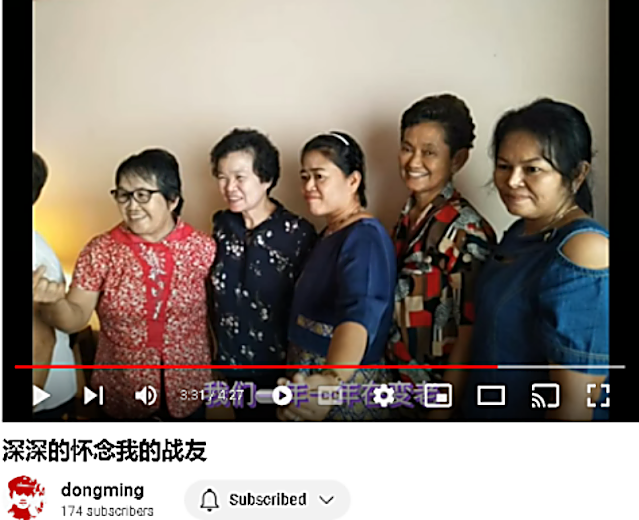
They're aunties with rolls of fat under their chins and ridges at the corners of their eyes. They're uncles with grey hair and corrugated foreheads and perhaps carrying the baggage of senility. But as members of the Malayan Communist Party in their younger days, they fought the Japanese Imperial Army together with the British Force 136. I write not to praise these resistance fighters but to remind the younger generation of the historical facts. The evil that men do lives after them, wrote Shakespeare. The good is oft interred with their bones. So let it be with the Malayan Communist Party --  often demonized and condemned in unfair ways -- which has left its footprints in our history books. 


https://www.youtube.com/watch?v=Br3omNXNIyI


Saturday, December 24, 2022

“Omigosh!” gasps Mummy Lulu. “The anthem of the Malayan Communist Party sounds like a love song!”

"Holy cow!” I grunt at my smart phone, held in front of me. “Why’re you wearing a Communist uniform?” I lean back in my chair and cross my legs.

Mummy Lulu and I are in the middle of a video call.

“I borrowed it for Hot Legs’New Year’s Eve costume party. Now trying it out while pottering around my garden.”  Mummy Lulu squints as she steps out of the shade of a tree into the sunlight.  “You know, you should change the music in your book trailer ‘Burma Road Driver, Resistance Fighter.' ”


https://www.youtube.com/watch?v=vrU4fJIEBJk

I rest the elbow of my phone arm on the arm of the chair.  “Oh, why?”

“I stumbled upon the anthem of the Malayan Communist Party on YouTube, sounds like a romantic song.”  The muscles shift in Mummy Lulu’s wrinkled throat.  “Use this song in your book trailer instead. Info about the MCP is hard to come by, always suppressed.” The moving background behind Mummy Lulu freezes as she plops on a garden chair.


https://www.youtube.com/watch?v=iQy-9-tbiP0

“But-history-is-history.” I spit the words out with emphasis, my voice turning to serious.  “No matter how much they’re hated by certain quarters, they fought against the Japanese.”

“Yup, accept them as part of Malaya’s history.”


https://www.youtube.com/watch?v=Bo4QXyRglkU

“Go tell that to certain quarters who regard the MCP—despite having surrendered and disbanded in 1989—like the bogeyman.”

Mummy Lulu’s voice rises above the soft chirping of birds. “Now, I called to ask whether you’re coming to our party.”

“He who misses it is a fool!”

Wrinkles fan from the corners of Mummy Lulu’s lips, creased in a grin. “Your fancy dress?”

A chuckle rumbles from my throat. “I wanna be on the same page as you. Mao Zedong’s jacket and a one-star cap.  See you, bye.”

/end

Thursday, December 16, 2021

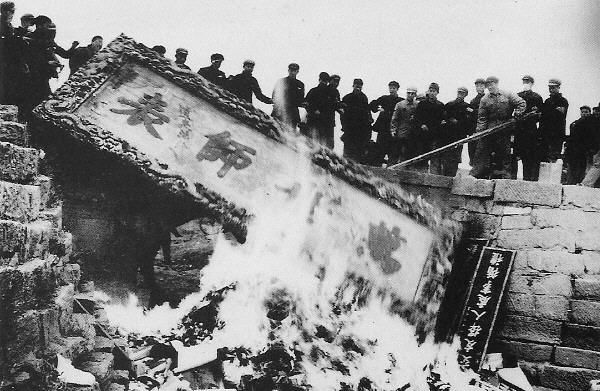
# 1 horror teaching of Mao Zedong during the Cultural Revolution (1966 to 1976)


“No gods shall tell us what to do. We are masters of our own destiny.”                                                                                                          -- Chairman Mao                                                                                     

As a result, thousands of temples, monasteries and statues of Taoist gods and of Lord Buddha were destroyed. 


After Mao’s death, religious freedom was restored but, till today, there is no official religion for the PRC.

Saturday, November 27, 2021

“The Kuomintang were barbaric towards Yang Kaihui, Mao Zedong’s second wife,” says Jessica, tears welling in her eyes.


“Jiang Qing was Chairman Mao’s fourth and most famous wife.” Jessica says as she pours tea into my cup. “Mao’s second wife, Yang Kaihui, was little known and what the Kuomintang did to her was barbaric!”


I take a sip of my tea, send my gaze heavenward and say,  “Tell me more about this Yang Kaihui.”

Jessica rests her elbows on the arms of her chair and steeples her hands. “Kaihui was the daughter of one of Mao’s teachers, Yang Changji. In 1918, when Changji was teaching in Beijing University, Mao met Kaihui when he accepted the post of assistant librarian. Two years later, the couple married.  They had three children. 

“In 1927, Mao was separated from his wife as he had to travel around the country to lead the revolutionary movement. So, Kaihui returned to her hometown Bancang in Hunan Province.  On October 24, 1930, General He Jian of the Kuomintang arrested her. He gave her two options—to publicly denounce the Communist Party and Mao Zedong and be released or to be executed. Despite being tortured, she refused to betray her husband. On November 14, she was executed by a firing squad. Another account said she was beheaded. She was only 29 years old.” Tears well in Jessica’s eyes and leave snail-tracks on her cheeks. “The story did not end there.


“In 1982, the government restored Yang Kaihu’s former residence to turn it into a museum. A worker found a letter hidden in a crack in the wall of her bedroom. The crack had been sealed with wax. In the letter, Kaihui expressed her love for her husband Mao and how much she missed him.
 

“An excerpt of the letter said, ‘I will kiss him a hundred times, his eyes, his mouth, his cheeks, his forehead, his head—he is mine. He belongs to me!’

"Mao was devastated by her death. When he came to power, images of Yang Kaihui appeared in several of his propaganda posters. He also wrote a poem in memory of her.”


My gaze glazes into a blur as hot tears scald my eyelids. By the time my tears stop, I am as emotionally tattered as the soggy Kleenex tissue in my hand. 

/end

Sunday, August 9, 2015

“Nagasaki survivors should shut the f*** up about the horrors of the atomic bomb, instead they should reflect on the atrocities of their Imperial Japanese Army,” rants Johnny Yap


[Pix of male model above for illustration purpose only]

On August 9, 1945, America dropped the atomic bomb on Nagasaki which killed around 80,000 to 100,000 civilians. Earlier today, memorial services were held in several places in Japan. “So, what's the big deal?” rants Johnny Yap, owner of Hot Legs Nightclub & Karaoke. “They deserve it! Today -- which is the 70th anniversary of the bombing -- its survivors should not talk cock about their sufferings but reflect on the atrocities committed by their own Imperial Japanese Army!" He thumps his table with his fist and glugs a mouthful of Tsingtao beer.


“To cite a few examples of Japanese war crimes," adds Johnny, wiping his lips with a piece of Kleenex, "the Burma Death Railway claimed the lives of 12,000 Allied POWs and 90,000 labourers, the Bataan Death March in the Philippines took the lives of 21,600 American and Filipino POWs. And the Sook Ching in Singapore left 70,000 to 90,000 Chinese dead! Figures for the Sook Ching in Malaya are estimated at 30,000, according to Wikipedia. Think about that! Nagasaki and Hiroshima deserve what they got!”


[Painting of "Bataan Death March" above courtesy of the artist Ben Steele]

/end


Monday, August 22, 2011

Mooncake festival celebrated grandly in Malaysia


The moon, long an object to curiosity and worship, has inspired many tales in ancient China. While on board a boat, Tang Dynasty poet Li Po was believed to have tried to embrace the reflection of the moon while he was drunk. He fell overboard and drowned. In days of yore, people regarded a round shape as family reunion; thus, an auspicious time for family members to get together was when the full moon appeared. At no other time of the year is the moon brightest and fullest on the fifteenth day of the eighth lunar month. This year, that auspicious day falls on September 12, 2011 (Monday), which is also known as the Mid-autumn Festival. Lantern processions and the eating of mooncakes are highlights of the celebrations.

In Malaysia, which has a Chinese population, the Mooncake Festival is also celebrated on a fairly grand scale with prayers and reunion dinners. Altars are set up in the open air under the moonlight, and offerings of pomegranates, pomelos, steamed sponge cake, water-calthrops, mini yams and mooncakes are laid. The moon is worshipped, and there is feasting, moon gazing and, in modern families, partying and drinking. Children carry lanterns and sometimes competitions are held. According to older generations, on this day, the taboo of not pointing to the moon should be observed, lest a moon fairy will cut off one’s ears!

Weeks before the festival, mooncakes and lanterns are put up for sale. In the Chinese districts of many cities, particularly Kuala Lumpur, Georgetown, Malacca and Ipoh, red boxes packed with mooncakes are piled high on the sales counters of restaurants, and lanterns in the shapes of animals, flowers, butterflies and cartoon characters dangle in clusters from toy stores and incense shops. In keeping with the times, some of the lanterns are operated by battery though those lighted by candles are still popular. Mooncakes are bought not only for prayer and consumption but to be given to friends and relatives.

Shaped like the surface of a moon, mooncakes come in various traditional varieties. They can be filled with black-bean paste, brownish lotus-paste, yellow-bean paste and lotus-seed mixed with sweetened paste. Usually, a preserved duck-egg yolk is added to the stuffing. These mooncakes are of the Cantonese version, and in addition, there are also less popular Hokkien-style mooncakes that come in long, cylindrical rolls and Teochew mooncakes filled with yam. In Malaysia, halal mooncakes are also available. To cater to the increasing sophisticated taste buds of Malaysians, bakeries have made innovations in mooncakes such as ice-cream mooncakes, pandanus moncakes, green tea mooncakes and durian mooncakes.

The origins of the Mooncake Festival have been lost in the mists of time, but there are two legends associated with it. The first concerns its role in the overthrow of the Yuan Dynasty (AD 960-1280) that was established by the Mongols in ancient China. Under the oppressive rule of the Mongols, gatherings of a group of people were forbidden, and it was decreed that each household be allowed to own only one kitchen cleaver, which was chained to a chopping block. It was impossible to organise any uprisings. Liu Fu Tong, a rebel leader of Anhui province, requested permission from the District Officer to distribute cakes to bless the longevity of the Mongolian emperor. The District Officer agreed, and Liu made thousands of round cakes which he called mooncakes. Each cake contained a piece of paper outlining the plan of an attack. He told the recipients to eat the mooncakes on the 15th day of he 8th lunar moon. On that fateful day, when the people cut the mooncakes, they were able to coordinate a rebellion on a local scale. Another rebel leader, Chu Hung Wu, capitalised on the chaos to overthrow the Mongol emperor, and established the Ming Dynasty in AD 1368).

Another myth concerns Chang Er, who was a daughter of a poor farming family. When she was 18, Hou Yi, a skilled archer from a neighbouring village, saw her attending to the fowls in her parents’ farm, and he was captivated by her beauty. Over the next few days, he deliberately rode passed the farm again and managed to introduced himself. She accepted his friendship, and soon they became lovers. During the period of their courtship, a phenomenon happened. The ten suns of the earth that took turns to bring warmth and light appeared together. Rivers dried up and the country became barren, causing famine and massive destruction.

Hou Yi climbed up to the highest mountain he could find and launched his mighty arrows. One by one, nine of the suns were shot down. The people rejoiced and made Hou Yi their King. He married Chang Er, and they lived happily for several years. However, Hou Yi changed into a despot, and tried to seek immortality. He employed sorcerers to produce an elixir of life for him. One prominent sorcerer told him Hou Yi that he needed children to be sacrificed as part of the process of creating the elixir. Hou Yi ordered his troops to snatch children from their families, and the elixir tablet was almost completed.

One evening, Chang Er sneaked in the sorcerer’s chamber that was housed in a tall tower in the palace. She rummaged everywhere and found the tablet. At that moment, the sorcerer burst in and Chang Er quickly swallowed the tablet. The sorcerer raised the alarm and in rushed Hou Yi who tried to force his wife to return the pill. It was too late. She had swallowed it, and in her attempt to escape from Hou Yi, she was forced to jump from a window. However, she did not fall but floated up to the moon, where she lives alone. Another version says that as punishment for stealing the elixir of life, Chang Er was turned into a three-legged toad. Her pet rabbit became her companion and is always pounding the elixir of immortality in a large mortar. Today, it is believed that people celebrate the Mooncake Festival to remember Chang Er.

/end